Thursday, March 24, 2011

Thursday 3/24-Stacey-Unit 10 Chemistry Practice

Along with the chemistry review we had due today, it was also a food day (optional).
Remember, tomorrow is the last day of the quarter and our Thermochemistry test is tomorrow!
Below are the answers to the Unit 10 Chemistry Practice packet, we didn't have to do
the first two pages of the packet (math skills and reading for information).

Our homework for tonight is to study for tomorrow's test. Also, make sure all the pages in your journal are finished!


Thursday 3/24 - Mike - Thermochemistry Review

Since it is the end of the third quarter, we started off class by eating all the food that everybody brought in for this quarter's food review today. After everybody was done eating, Mr. Tucker stamped our homework that was due today. Below you can see pictures of the homework, done step-by-step.


After stamping the homework, Mr. Tucker reviewed problems from all three pages with us in class. Following this review, we proceeded to discuss and take notes on energy diagrams. Below you can see a picture of the notes we took in class.


After taking notes there was only ten minutes left in class, so Mr. Tucker let us work on two review sheets on our own in class. Below you can see pictures of the review sheets, done step-by-step with work.

The homework for tonight is to STUDY FOR OUR TEST TOMORROW.

Wednesday, March 23, 2011

Thurs, 3/23, Eiesland


Today we started class by doing the Combustion Lab as a class. This lab's main question was: How much energy is released in the burning of candle wax? To figure this out, we measured and massed 100 ml of water in a beaker and then placed it over a small, burning candle underneath. Before we placed it above the burning candle, we massed the burning candle. We waited for the candle to heat up the beaker a little bit before taking the water's temperature again and then massing the candle one more time. Once we concurred that the mass went down because some of the wax had changed because of the reaction that took place (Wax + O2 -> CO2 + H2O + Heat), we were then able to plug our data into our formula (Heat = mc [delta] T).
Scroll up for the two pictures that explain all of our data and what we ended up doing for the equation.

After we finished the Combustion Lab, Mr. Tucker checked in our homework. We went through a few problems and if you want to see some problems and the answers, Kim posted some on her blog for Tuesday, March 22.

We learned something new today : Energy Diagrams! Mr. Tucker pointed out like 10 times that an Energy Diagram ( which has a curve) is NOT the same thing as a Heating Curve ( which looks more slanted steps ( 2 plateaus, 3 slopes). So don't confuse them! Here are the notes/diagrams from these two pages ( pages 7 & 8). ( scroll up for pictures)

Our homework for today is to do the Unit 10 Chemistry Practice packet ( but skip the math skills and reading for information sections) and if you want to, the 3rd quarter food review. It's due tomorrow ( Thursday) and I'm putting a picture on to show you what's required in the flyer. ( scroll up for pictures)


Tuesday, March 22, 2011

Tuesday 3-22-Bernstein-Energy Stoich


Here are the pictures from the last blog for questions 1 and 6 for pages 5 and 6 in your journals.
Use the pages from my last post for these answers.
The homework tonight is to finish page 5 and 6 in your journals. For question 1 part c, you do not have to answer that. The test is on FRIDAY so make sure you start studying and ask any questions you have referring to this unit!

Tuesday 3-22-Bernstein-Energy Stoich

1. The first thing we did today in class was get journal pages 5 and 6. The bottom picture is page5 and the top picture is page 6.


2. The next activity we did was go over the Heat Fusion Lab. If you were not hear within the last few days of class, you can get the pages from the previous blog. We first discussed what happened to the water and ice during this experiment. The ice was menting in the water. Two things happened in the cup:


1. Ice melted


2. The water was getting colder


In this experiment, we looked at what the endothermic and exothermic items were. The endothermic, or the process that gains heat, was the ice. As the ice was being stirred in the water, the ice was absorbing heat and making the ice colder. The exothermic, or process that losses heat, is the water because it is losing heat. Mr. Tucker drew us a picture of a glass with one ice cube in it. He then drew and arrow, coming from the water, to the ice cube. this shows the process that occurred in the experiment. The ice absorbed the heat coming from the water which caused the ice to melt and the water to lower in temperature. This picture also shows us how the ice is endothermic and the water is exothermic.


We also discussed the important notification that HEAT LOST = HEAT GAINED. The equation for this is M x C x delta T (Tf-Ti) = M x Hf (Heat of fusion).


3. The next thing we did was look at the data table from the experiment. We only did one trial for the experiment, so don't do trial 2. Our data that we got is as follows:


Trial 1


Mass of dry calorimeter: 4.02 g


Mass of calorimeter and water: 97.6 g (should be close to 100)


Initial Temp. of water: 23 degrees Celsius


Final Temp. of water: 4 degrees Celsius


Mass of calorimeter and water after ice melted: 121.23 g


4. We then began doing the Heat of Fusion Lab Calculations and Questions.


1. Find the mass of the original amount of water in the calorimeter. 97.60 g H2O(l)


2. Find the mass of the water resulting from the melted ice. 23.63 g H2O(s)


3. Find the change of temperature of the water. 19 degrees Celcius


4. Find the amount of heat lost by the original amount of water when it cooled. (specific heat of water is 4.18 J/g C)


97.60 g x 4.18J/ g C x 19 C = 7751.39 J sig figs! So the answer is 7751 J


5. Find Heat of Fusion for the ice. 7751 J= 23.63 g x Hf. Divide both sides by 23.63 g =328 J/G


6. Skip this problem


Questions.


1. Is the process of ice melting endothermic or exothermic? Heat goes into the ice cube, so endothermic


2. Is the process of ice freezing endothermic or exothermic? Since heat leaves the ice, making it freeze, it is exothermic


3. Compare your heat of fusion to that in your notes? Ours is 328 J/G and the real heat of fusion is 334 J/G.


5. After reviewing the lab, we began to do page 5 and our new lesson for the day, ENERGY STOICH. Above were the journal pages so look back to those for the problems. We did problems 1 and 6 together so that is what I am going to show you how to do.

Monday, March 21, 2011

Monday 3-21- Olivia- Thermochemistry


Today we started off class with picking up a lab and our homework. Mr Tucker than checked in the 10 minutes of homework we were to do last Thursday night. We then went through questions anyone had from the homework. It was page 2 and we went over number 4, 5, & 7.


To the left is the picture of the homework, but below is the picture of what we went over, step by step, in class.


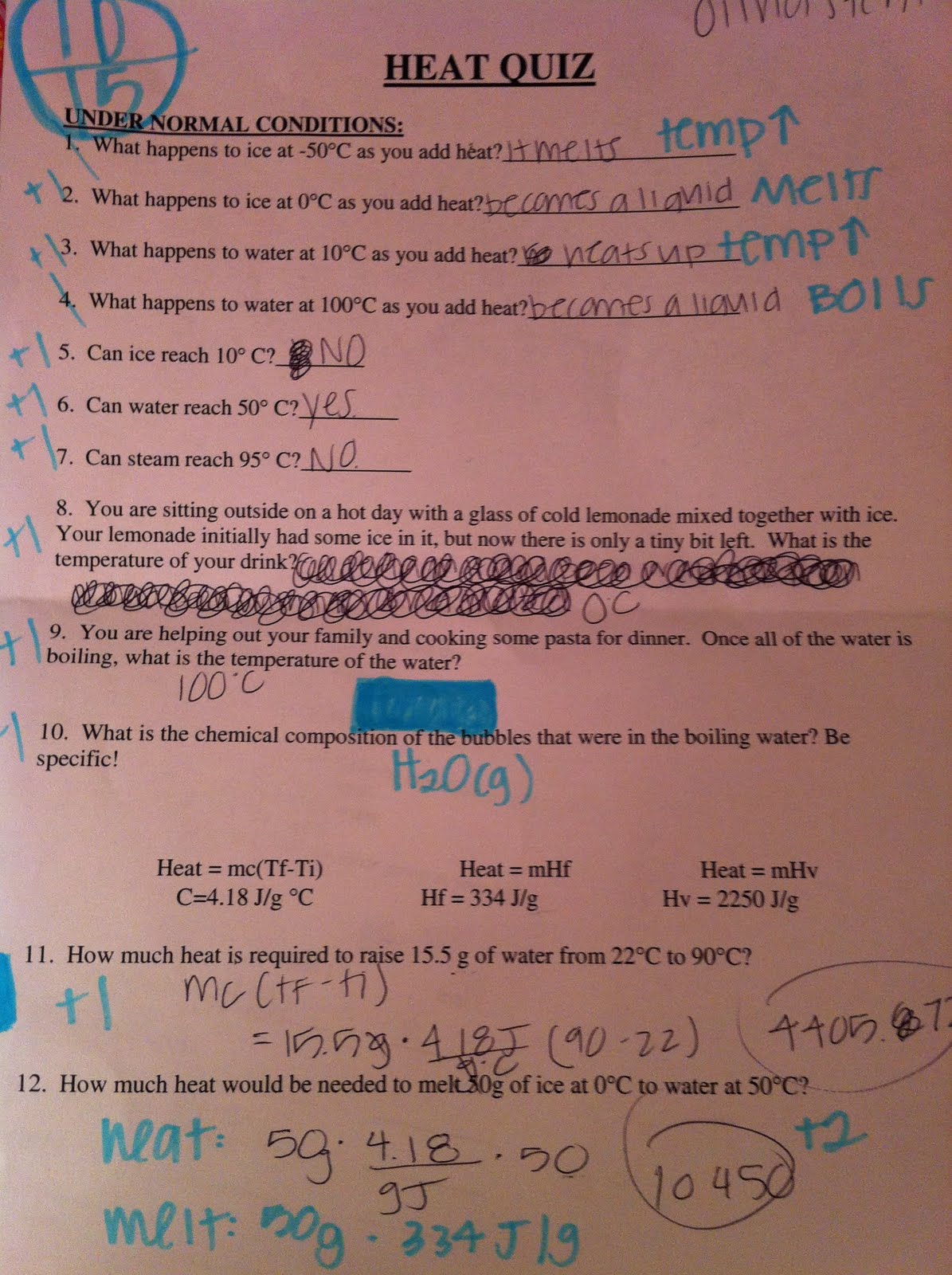
After this, we did our first quiz of the unit, Heat Quiz. It was based on what we learned from last week before the chem day.


this quiz was 15 points and can be made up by Thursday.


The Unit Eleven test is on Friday March, 15th, so if you will be gone on that day for Spring Break, Mr. Tucker strongly suggests you take it before Spring break.


Finally, for the last five minutes of class, we went back to our lab tables and began the lab by heating the water that was initially 50 degrees Our homework for tonight is page 4 Heat Calculations 3 that we picked up in the beginning of class.

Saturday, March 19, 2011

F-3/18- Audrey – Chemday

Today we went to the auditorium for chemday to watch an episode of MythBusters called Crimes and Myth-Demeanors 2.

The teachers handed out a paper with the questions related to the show.

Here are the following questions:

1. The fingerprint lock is an optical sensor.

2. What do Jamie and Andy have to do in order to break into Grant’s lock?

They need Grants fingerprint.

3. Which method of lifting prints works?

They added powder to the glue print.

4. Why doesn’t the paper print work?

It’s not three- dimensional.

5. In thermal motion alarms, what sets off the alarm?

Infrared energy

6. Why did Tory set off the alarm?

His body heat was picked up by the alarm.

7. What problems are involved with using a CO2 extinguisher to cool Tory?

It would be difficult to have a consistent temperature in the body because it’s just going to be a blast. So he can just heat it right back up in the middle of the room. Also it is dangerous can it can cause frostbite.

8. Which material was more like human skin? Did it work?

They use a Ballistics gel. But no it didn’t work because the ridges are not deep enough.

9. Was the Team able to covertly get Grant’s fingerprint?

Yes, Carrie is able to get Grant’s fingerprint by using a cd case.

10. Why does the second print work?

The lines of the fingerprints are clearer.

11. Why did the neoprene suit set off the alarm?

The longer Tory wears the suit the heat from his body is transferred in the suit.

12. Did the Predators method of pasting yourself with mud fool the alarm?

No, because the body heat warmed up the mud. Also there are mud tracks left.

13. How did Adam’s fingerprint work?

They made a latex copy that is planted on his heated thumb and then he licked it.

14. What happened with the photocopy print?

They are able to get in.

15. What happened when they increased the room temperature?

A huge hot stream is flowing in the room setting off the alarm.

16. Did a near naked Grant fool the alarm?

No, because the alarm is just too sensitive.

17. How does the big pane of glass work?

The glass can block the infrared of the body.

18. Did the glass method work?

Yes

19. What is glass- re- locker?

A pane of breakable glass within the safe itself that if broken activates locks that makes the door impenetrable.

20. How many milliliters of nitroglycerine does Adam think he needs?

140 ml of nitroglycerine

21. Where are they testing the safe?

They are doing their test at a sewage plant.

22. How big is the glass in the actual safe?

The size is a small glass in the middle of the safe.

23. What are the five steps to blow up the safe?

Step 1, is to bore a hole in the top of the safe with a thermo lance. Step 2, is to fill the safe with water. Step 3 is to lower explosives into the safe. Step 4 is to blow the door of the safe and step 5 is to get the money and run.

24. What was the problem when they burned a hole in the safe?

It also burned everything in the safe.

25. How does the ultrasonic motion detection work?

It sets out a very high frequency sound wave which bounces off in all the wall of the room and comes back to the sensor to create a pattern.

26. What material soaks up the sound?

A thick rug.

27. Does Carrie’s bird suit work?

No it didn’t.

28. Does the bed sheet work? Why?

Yes, because the bed sheet is actually absorbing the sound wave.

29. What was the last method used to fool the alarm? Why does it work?

The last method is to slowly walk in the room. This method worked because the sensor has a threshold level of movement that needs to trigger it.

30. Were Adam and Jamie even able to copy the safe breaking Crime?

Yes

REMEMBER THE HW ON THERMOCHEMISTRY WHICH WE WILL GO OVER ON MONDAY.