1. The first thing we did today in class was get journal pages 5 and 6. The bottom picture is page5 and the top picture is page 6.
 2. The next activity we did was go over the Heat Fusion Lab. If you were not hear within the last few days of class, you can get the pages from the previous blog. We first discussed what happened to the water and ice during this experiment. The ice was menting in the water. Two things happened in the cup:
1. Ice melted
2. The water was getting colder
In this experiment, we looked at what the endothermic and exothermic items were. The endothermic, or the process that gains heat, was the ice. As the ice was being stirred in the water, the ice was absorbing heat and making the ice colder. The exothermic, or process that losses heat, is the water because it is losing heat. Mr. Tucker drew us a picture of a glass with one ice cube in it. He then drew and arrow, coming from the water, to the ice cube. this shows the process that occurred in the experiment. The ice absorbed the heat coming from the water which caused the ice to melt and the water to lower in temperature. This picture also shows us how the ice is endothermic and the water is exothermic.
We also discussed the important notification that HEAT LOST = HEAT GAINED. The equation for this is M x C x delta T (Tf-Ti) = M x Hf (Heat of fusion).
3. The next thing we did was look at the data table from the experiment. We only did one trial for the experiment, so don't do trial 2. Our data that we got is as follows:
Trial 1
Mass of dry calorimeter: 4.02 g
Mass of calorimeter and water: 97.6 g (should be close to 100)
Initial Temp. of water: 23 degrees Celsius
Final Temp. of water: 4 degrees Celsius
Mass of calorimeter and water after ice melted: 121.23 g
4. We then began doing the Heat of Fusion Lab Calculations and Questions.
1. Find the mass of the original amount of water in the calorimeter. 97.60 g H2O(l)
2. Find the mass of the water resulting from the melted ice. 23.63 g H2O(s)
3. Find the change of temperature of the water. 19 degrees Celcius
4. Find the amount of heat lost by the original amount of water when it cooled. (specific heat of water is 4.18 J/g C)
97.60 g x 4.18J/ g C x 19 C = 7751.39 J sig figs! So the answer is 7751 J
5. Find Heat of Fusion for the ice. 7751 J= 23.63 g x Hf. Divide both sides by 23.63 g =328 J/G
6. Skip this problem
Questions.
1. Is the process of ice melting endothermic or exothermic? Heat goes into the ice cube, so endothermic
2. Is the process of ice freezing endothermic or exothermic? Since heat leaves the ice, making it freeze, it is exothermic
3. Compare your heat of fusion to that in your notes? Ours is 328 J/G and the real heat of fusion is 334 J/G.
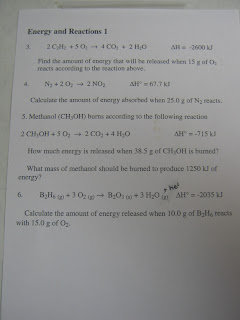
5. After reviewing the lab, we began to do page 5 and our new lesson for the day, ENERGY STOICH. Above were the journal pages so look back to those for the problems. We did problems 1 and 6 together so that is what I am going to show you how to do.


