Wednesday, March 9, 2011

Chemistry Period 2nd - Equilibrium - Nikki Lipinski (March 8, 2011)

Today, we started Chemistry by taking four jurnal sheetes. The sheetes included:

- Frayer Charts

- Equilibrium notes

- Jurnal Sheet nr. 4 - Le Chatelier 1

- Jurnal Sheet nr. 12 - Equilibrium 2

Mr. Tucker has begin class with reminding us that he will not be in school on Thursday March 10 and Friday March 11, so we have two days for review for TEST on Monday March 14, 2011.

Next we and Mr.Tucker read pages from our textbook (549 - 550), Chapter 18 Section 2. The text was about Reversible Reactions and Eequilibrium. Now we know that a reversible reaction is one in which the conversion of reactants to products and the conversion of products to reactants occur simultaneously.

Example:

2SO2 (g) + O2 (g) <------> 2SO3 (g)

After reading Mr. Tucker gave us few minutes to fill up Frayer charts. We were suposed to write our definition, picture, non- examples and examples of EQ (equlibrium). Then our chemistry teacher explained to the class what is equlibrium.

Equlibrium is a revesible reaction in whichconcentration of reactants + products are constant. Equilibrium is only for gases (g) and substances which soluble in water (aq).

The Equilibrium can be measured:

Keq = [products] / [reactants] [] - stands for M

Homework:

Jurnal page 4 and questions 1,2 and 4 from page 12

Tuesday, March 8, 2011

Ellie-Tuesday, 3/7

Today in class we...
1) Picked up 4 journal pages and a short reading
~The four journal pages were "Frayer Charts", "Equilibrium Notes", "Equilibrium 2"(page 12), and "Le Chatelier 1"(page 4)
~The reading was on equilibrium
2) Read through the short reading. Used the reading to fill in The Definition, Picture, Non-example, and Example on the "Frayer Charts" journal page.
3) Went over Frayer Charts and had people come up to the projector and show their examples/pictures.
4) Went through the Equilibrium Notes, and went through how to solve if you shift to left (reverse) or right (forward)
~A(g)+B(G)<---->AB(g)+heat
More/Less Products:
Add more AB, shift left
Take away AB, shift right

More/Less Reactants:
Add more B, shift right
Take away A, shift left

Energy:
Lower the temp., shift right
Increase the temp., shift left

Pressure:
Increases pressure, shift right
Decreases pressure, shift left

5) Moved on to Number one on the journal page "Equilibrium 2"

1. 2 NH3(g) <----> N2(g)+3H2(g) K=6.56 x 10^-3
In an equilibrium mixture of the gases above [N2]=0.045M and [H2]=0.0056M. Find [NH3].

K=[N2] x [H2]^3
---------------
[NH3]^2

6.56 x 10^-3
.00656= .045M x (.0056)^3
------------------------
X^2

.00656= .045 x .000000176
------------------------
X^2

X^2 x .00656 .000000008
----------------- = ------------------
.00656 .00656

Square root of x^2=square root of .00000125
X=.001118

6)Did number one on Le Chatelier 1
a. carbon dioxide is removed- right
b. water vapor is added-right
c. the pressure is increased-NS

7) Was assigned homework: to do numbers 2 and 4 on Equilibrium 2 and numbers 2 and 3 on Le Chatelier 1

Thursday, March 3, 2011

Thu, 3/3, Tucker

Today each lab group performed a short lab involving a reaction with alka-seltzer and water.  The reaction produced a gas and when this reaction occured in a flask with a balloon placed over the top of the flask, we were able to time the reaction...how long did it take for the balloon to inflate?  Since different groups investigated different independent variables, we then shared data/conclusions with the class.  The three labs are outlined below:

WE JUST WROTE THIS LAB IN OUR JOURNALS!!

Lab 1:
Procedure:  Place 1/4 alka seltzer tablets in 25ml of water in a 50ml flask and place a balloon over the top of the flask.  Time how long it takes for the balloon to inflate.  Repeat with 1/2 and full tablets.
Data:
1/4tablet-  45sec
1/2 tablet-  14sec
1 tablet-  6sec
Conclusion:  As concentration increases, so does the speed of the reaction

Lab 2:
Preocedure:  Place 1/2 alka seltzer in in 25ml of water in a 50ml flask and place a balloon over the top of the flask.  Time how long it takes for the balloon to inflate.  Repeat with a crushed alka-seltzer (which has more surface area!)
Data:
1/2 tablet -  16sec
1/2 tablet crushed- 5sec
Conclusion:  As surface area increases, so does the speed of the reaction

Lab 3:
Procedure:  Place 1/2 tablet of alka-seltzer in 25ml of room temperature water (22 degreesC) in a 50ml flask and place a balloon over the top of the flask.  Time how long it takes for the balloon to inflate.  Repeat this with 5degreesC water and 50 degreesC water.
Data:
5C- 2min, 20sec
22C-  20sec
50C-  4sec
Conclusion:  As temperature increases, so does the speed of the reaction

The independent variables for the lab were concentration, surface area, and temperature
The dependent varibale for the lab was time / speed of the reaction
The controlled varibales for the lab were the size of flask, type of tablets, and amount of water.

Wednesday, February 23, 2011

Tuesday 2-22 Erick

To Begin class today we went over the lab test from Friday and went over many different ways to solve the problem. To Refresh on Friday we were given salt and asked to create a solution with a .15 molarity. One of the ways that was brought up was to use a sample volume and calculate the number of mols. Here's a different way to solve the problem.

.15M= Mol’s Liters 1.5 g NaCl 1mol

58.44 g NaCl 1.5/58.44

.15M= .o2567mol/ x

.171L

171ML

After we went over the different ways to solve the lab quiz we were given a sheet to complete on chemthink. To get to the lab go to chemthink click labs chemical reations labs and then click Precipitate lab.

After we briefly went over the lab we took notes on the rules of solubility.

Compounds always Soluble in water

Unless they have this

Ammonium NH4

Potassium K

Sodium Na

Nitrate NO3

Chlorine CL

Ag Hg Pb

Acetate C2 H3 O2

Fe Al Hg2

Sulfate

Ca Ba Pb Sr Hg2

Compounds always insoluble

Unless they have this

Oxide O2

K Na NH4 LI

Carbonate Co3

K Na LI NH4

Hydroxide OH

K Na Ba LI

Phosphate PO4

K Na NH4

Silicate SiO3

K Na

Sulfide S2

K Na NH4

Sulfite SO3

K Na NH4

The homework for the night was to Complete the lab on chemthink and to continue practicing solubility reatcions.

Monday, February 21, 2011

Fri- 2/18- Mackenzie


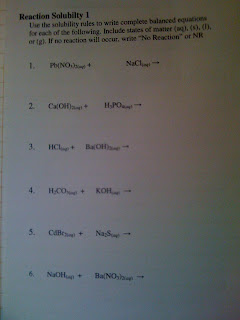
1. We began the day by picking up two sheets from the front. The first sheet was Molarity 2 and the second sheet was Reaction Stability 1.

Here is what they look like:


2. We went over the Molarity 1 worksheet that was assigned Thursday night for HW.

Examples:


3. We did some problems on the Molarity 2 worksheet. Mr.Tucker said that you don’t need to do #2 but it will help you for a test. He also pointed out that Molarity is the same thing as concentration so when Molarity increases so does the concentration.

Examples:


4. HOMEWORK:

Reaction Solubility 1-

*They are all double replacement reactions

*Remember: First balance the charges then balance the coefficients.


Thursday, February 17, 2011

Thurs-2/17-Wittenstein

We first picked up two new sheets at the beginning of class, they were about Molarity, and Dissolving.

Next, Mr. Tucker gave us a practice quiz to see how much we knew on the solutions notes from yesterday. The quiz was about comparing solutions, colloids, suspensions and pure substances and how to find out which is which using techniques such as;
  • Shining a Light
  • Shaking
  • Filtering
  • Heating
This is what the quiz was:
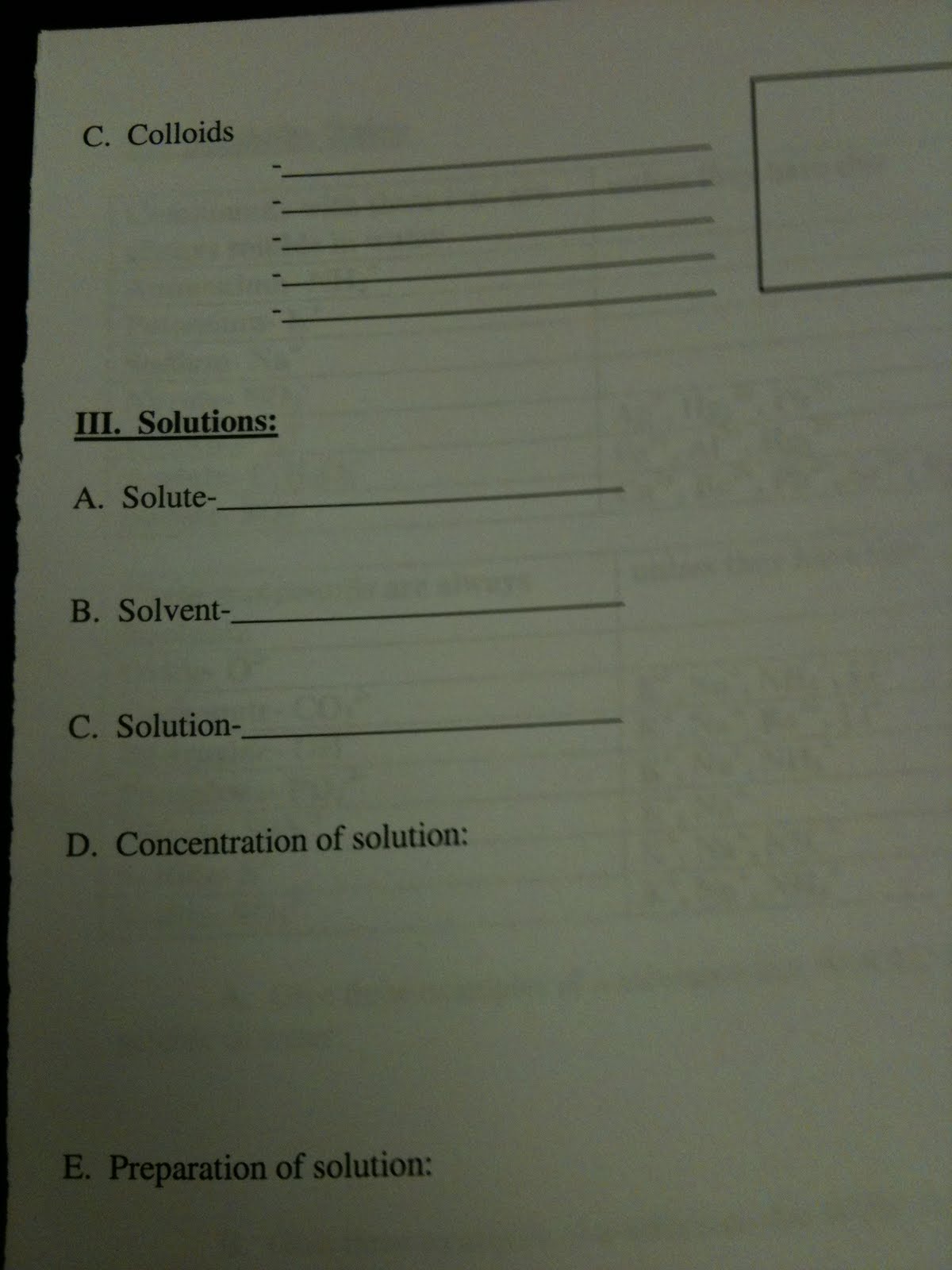
Next we finished our solutions notes from the solutions notes sheet:
Mr Tucker said that 99% of the solvents we will use will be water.
We then went on to do the dissolving notes:

Remember to make sure if it is an ionic or covalent bond so you know how it reacts. Also, when you are doing the drawings, DON'T FORGET to write H2O in the beaker.

Finally, our HOMEWORK was the 2nd sheet that we picked up at the beginning of class, it was about Molarity:
To get Molarity, you divide the mols by the liters. Make sure that you turn mL into L before doing the problem. Also, at the bottom of the sheet, we have to find the L. And to do this, we divide the mols by the Molarity.

HOMEWORK: Molarity 1 sheet

Wednesday, February 16, 2011

Wed.-2/16-Barberis

Today in class we received 6 sheets of paper.
-4 pages of notes on solutions
-2 pages to mixture lab


Next Mr. Tucker talked about the journal quizzes from yesterday, and about the Stoichiometry exams. He also handed back the lab tests. Your group needed to turn in both the pages (data page and lab exam page) for full credit.

Then we started working on the Mixtures lab as a class. Mr. Tucker had 4 different liquid mixtures on his desk and he did 4 tests on them to determine what type of mixture they are (explained later in solutions notes).

First, as a class we examined the color and clarity of each of them.

First was milky color and clarity
Second was transluscent and dyed light blue.
Third was very muddy and murky and completely opaque.
Fourth looked identical to water.

The next thing we did to determine what type of mixture each of them was, was shake them up.

First stayed the same
Second stayed the same
Third got dark brown after shaking, but then went back to brown.
Fourth stayed the same

Third thing we did was shine a flashlight through them and see if light went through.

First- didn't go through
Second- went through
Third- Didn't go through
Fourth- Went through

We did the same with a laser pointer and the results were the same as well.

Next we went back to our lab stations with our groups and filtered each substance through filter paper.

First- Were the same before and after filter.
Second- Were the same before and after filter
Third- In the unfiltered water and also in the filter tiny chunks of dirt were still apparent, but not in the filtered beaker.
Fourth- Were the same before and after filter.

We then made a data table over all of the data we received.

After we did the lab we sat back in our seats and went over the Solutions Notes sheets.
Here is a picture of what notes we took in class.